


Partial orthodontic treatment
See all treatments
Partial orthodontic treatment
Hamille Tokyo Dental Office
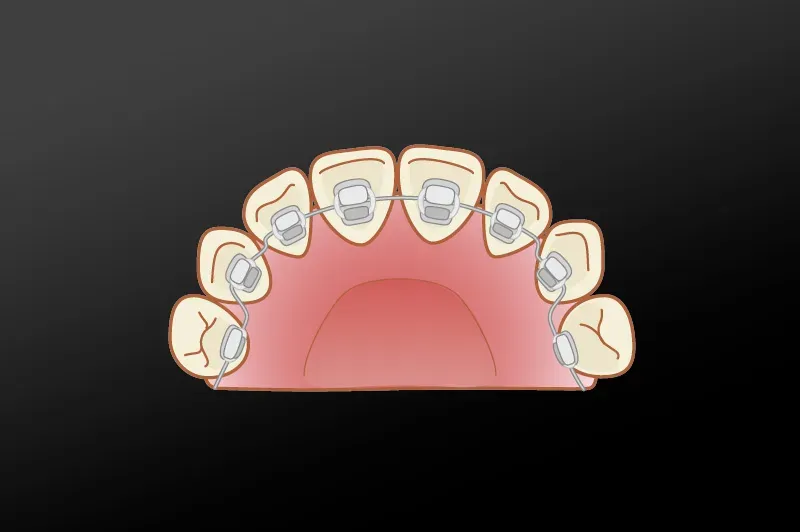
This orthodontic method moves only a limited range of teeth, such as the front teeth. We look at your overall bite to diagnose whether your teeth are suited to it.
About partial orthodontic treatment
This orthodontic method moves only a limited range of teeth, such as the front teeth. We look at your overall bite to diagnose whether your teeth are suited to it.
Partial orthodontic treatment can limit which teeth move, but it cannot make major changes to the jaw bone or the bite of the back teeth. Judging by appearance alone, some misalignment of the bite may remain. Depending on the results of a detailed examination, we may recommend full-mouth orthodontic treatment or another approach instead.
Who partial orthodontic treatment suits
Patients concerned only with the appearance of their front teeth
This suits you if there is no problem with the bite of your back teeth and you are concerned only about the look of your front teeth. For mild crowding or gaps, partial orthodontic treatment alone can give a good result.
Patients worried about relapse after orthodontic treatment
If you have had orthodontic treatment before and your teeth have shifted slightly out of line because a retainer wasn’t worn enough, partial orthodontic treatment is also worth considering. Where the relapse is mild, it can sometimes straighten the teeth again.
Patients who want treatment finished quickly
It is also an option if you are working to a deadline, such as a wedding or a job search. Compared with full-mouth orthodontic treatment, it is easier to complete within a shorter time.
Patients who want to keep costs down
Because fewer teeth need to move, the cost of this treatment is easier to control than full-mouth orthodontic treatment. Whether it suits you depends on the state of your teeth, so this needs to be confirmed by an examination first.
Advantages and disadvantages of partial orthodontic treatment
Advantages
- Fewer teeth move, so treatment tends to take less time
- Fewer appliances and check-up visits make the cost easier to control
- Treatment starts on a visible area, such as the front teeth, so the change is easy to see
- Fewer teeth move, so pain and the feeling of something in your mouth are also lighter
Disadvantages
- Suitable only for mild to moderate misalignment
- The main aim is to improve appearance, and improving the overall bite can sometimes be difficult
- It relapses more easily than full-mouth orthodontic treatment, so wearing a retainer matters even more
Points to consider before partial orthodontic treatment
Treatment range
It is suitable only for a limited area, such as mild gaps or overlapping front teeth.
Bite
Besides the front teeth, we also need to check how the upper and lower teeth and the back teeth bite together.
Retention after treatment
To stop the moved teeth relapsing, you will need to wear a retainer and come in for regular check-ups.
About clear aligner partial orthodontic treatment
Partial orthodontic treatment with clear aligners is hard to notice because the material is transparent, and you can take them out yourself, so you can eat and brush your teeth as usual. There is no need to worry about a metal allergy with this treatment, and the feeling of something in your mouth is also lighter.
We use Invisalign for clear aligner treatment, taking detailed impressions of your teeth with an iTero intraoral scanner. This treatment focuses on the front teeth and suits mild to moderate misalignment.
Recommended for
- Patients who don’t want people around them to know they are having orthodontic treatment
- Patients whose work involves frequent contact with people, such as reception or sales
- Patients who want to eat and brush their teeth as usual
- Patients with a metal allergy
Treatment process
Initial consultation
We ask about what concerns you have with your teeth and what you would like from treatment.
Detailed examination
We check the alignment of your teeth, your bite, and the condition of your gums and jaw bone.
Treatment plan explanation
We explain whether partial orthodontic treatment suits you, the treatment method, and an estimate of the treatment time and cost.
Orthodontic treatment
You use the appliance as planned, and we regularly check how your teeth are moving and the condition of your mouth.
Retention and maintenance
After treatment, a retainer keeps the teeth from relapsing, and oral care helps prevent tooth decay and periodontal disease.
Important points about orthodontic treatment
During treatment you may experience tooth pain, a feeling of something in your mouth, and difficulty keeping your teeth clean. There are also risks such as root resorption, gum recession, tooth decay, periodontal disease and relapse after treatment, so we choose the treatment method based on the examination results.
FAQ about partial orthodontic treatment
Q1. How do I choose between partial and full-mouth orthodontic treatment?
If there is no problem with the bite of your back teeth and you are concerned only about the appearance of your front teeth, partial orthodontic treatment suits you. If there is a bite problem or more severe misalignment, we may recommend full-mouth orthodontic treatment instead. Which one suits you is diagnosed from the results of a detailed examination.
Q2. About how long does partial orthodontic treatment take?
Treatment time varies by case, roughly from a few months to around 1 year. If the misalignment is mild, it may be finished in less time. We will explain the likely treatment time based on the examination at your first visit.
Q3. Can partial orthodontic treatment also relapse?
Even with partial orthodontic treatment there is a risk of relapse, and it tends to be somewhat higher than with full-mouth orthodontic treatment. Wearing a retainer after treatment to keep your teeth stable is an important part of the process.
Q4. Can teeth further back than the front teeth also be moved?
Depending on the case, it is sometimes possible to move the premolars near the front teeth as well. But if the back teeth need to move a great deal, full-mouth orthodontic treatment may be needed instead.
Q5. Are there any dietary restrictions during partial orthodontic treatment?
With clear aligners, you take them out to eat, so there are no particular dietary restrictions. While wearing them, we recommend avoiding drinks other than water, to prevent staining or warping.
Q6. Does partial orthodontic treatment also require tooth extraction?
In most cases, partial orthodontic treatment does not require tooth extraction. If the overlapping is severe, we may recommend full-mouth orthodontic treatment instead. We may also very slightly file the sides of the teeth to create a small amount of space.
Booking and enquiries
