


Periodontal regeneration
See all treatments
Periodontal regeneration
Hamille Tokyo Dental Office
Are you struggling to stop periodontal disease before it costs you a tooth? At our clinic, we may be able to restore you to full health.
Periodontal regeneration
Periodontal treatment used to stop it getting worse — now it can restore what was lost
Are you struggling to stop periodontal disease before it costs you a tooth? At our clinic, we may be able to restore you to full health.
What is periodontal disease? See here for details
About periodontal diseaseCan periodontal disease be cured?
Periodontal disease was once called an incurable condition, but as periodontal treatment has advanced, it is now possible to stop it progressing. This is limited, though, to controlling inflammation, restoring a healthy state and halting further deterioration — it cannot bring back gum tissue that has already receded.
A. Bone that has been lost cannot be restored.
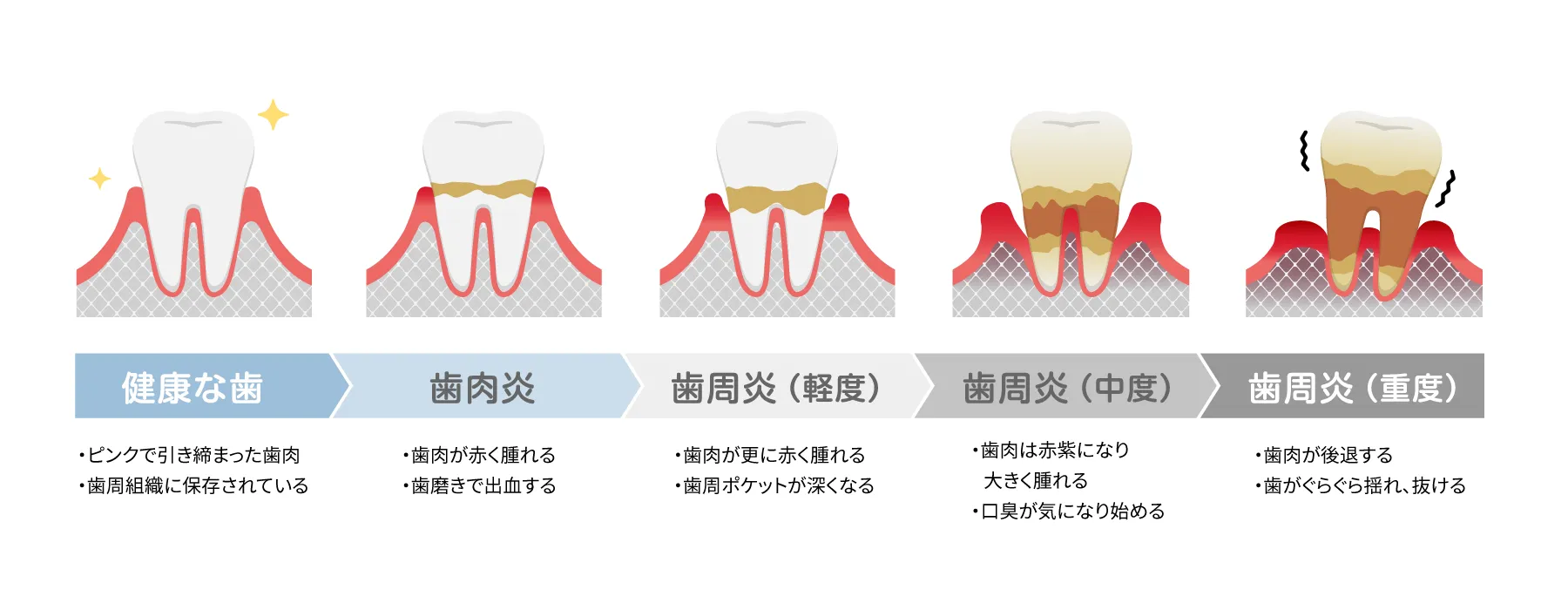
The option of regeneration
In recent years, periodontal treatment has moved on again, from simply stopping the disease to actual regeneration. In other words, regenerating tissue that has been destroyed and restoring your teeth as closely as possible to their original healthy state — this is periodontal regenerative treatment, the most advanced option available.
If you have been diagnosed with periodontal disease, told you need a tooth extracted because of it, or want to improve gum recession, please feel free to talk to Hamille whenever it is troubling you. At our clinic, we may be able to restore you to full health.
Ways to keep your teeth for longer.
Treatment using Emdogain (the EMDG method)
Inflammation reaches deep into the gums and destroys periodontal tissue (bone loss, gum recession). ⇒ Periodontal surgery using Emdogain can regenerate and restore the tissue that has been lost.
What is Emdogain?
Emdogain is a periodontal regeneration therapy that can regenerate periodontal tissue — including the bone that supports the teeth (the alveolar bone) and the periodontal ligament — that has been lost to periodontal disease.
A protein is applied to the root surface to recreate an environment similar to when the tooth was first forming, which promotes periodontal regeneration. The therapy is used in more than 40 countries and regions worldwide, its safety has been thoroughly verified, and it was approved by the Ministry of Health, Labour and Welfare in 2002 and designated as advanced medical care in 2007.
- Indications for Emdogain
- 〇 Vertical bone defect — a condition where the bone around a single tooth has a vertical dip.
〇 Furcation involvement — a condition where periodontal tissue damage has spread to the point where the tooth’s roots divide.
〇 Gum recession — a condition where the gums have receded, making tooth decay or periodontal disease more likely.
Treatment process
Incision
After administering anaesthetic, the gum tissue at the treatment site is incised.
Removal
Plaque and tartar on the root surface are removed.
Application
Emdogain gel is applied to the area of bone loss.
Suturing
The incised gum is sutured, completing the treatment.
Treatment using GTR (guided tissue regeneration)
The two most common periodontal regeneration therapies are GTR and Emdogain.
Years of research have shown no significant difference in outcome between the two, but GTR requires a high level of skill to place the resorbable membrane correctly, and carries an infection risk if the membrane becomes exposed.
* Emdogain is now the mainstream option, so due to this risk we do not perform GTR at our clinic.
About Bio-Oss
Inflammation reaches deep into the gums and destroys periodontal tissue (bone loss, gum recession). ⇒ Periodontal surgery using Bio-Oss, a bone graft material that can replace the tissue that has been lost.
What is Bio-Oss?
This is a bone graft material used to build up bone where the volume or thickness is insufficient. It is mainly used alongside GTR or Emdogain to build up bone to the point where implant surgery becomes possible.
Bio-Oss is a bone graft material derived from natural bovine bone. It integrates well with the human body and carries a low infection risk, so it is used widely around the world. Its safety and efficacy were approved by the Ministry of Health, Labour and Welfare in 2011.
- Indications for Bio-Oss
- 〇 Vertical bone defect — a condition where the bone around a single tooth has a vertical dip.
〇 Furcation involvement — a condition where periodontal tissue damage has spread to the point where the tooth’s roots divide.
Treatment process
Incision
After administering anaesthetic, the gum tissue at the treatment site is incised.
Removal
Plaque and tartar on the root surface are removed.
Application
Emdogain gel is applied to the area of bone loss and Bio-Oss is packed in.
Suturing
The incised gum is sutured, completing the treatment.
Treatment using CTG (connective tissue grafting)
Connective tissue is one of the three layers that make up the gum tissue — epithelial tissue, connective tissue and periosteum. CTG is a periodontal surgical treatment that grafts connective tissue from elsewhere in the mouth to areas that have become recessed or lost tissue through gum recession or root exposure, restoring both appearance and function.
- Indications for CTG
- 〇 Vertical bone defect — a condition where the bone around a single tooth has a vertical dip.
〇 Gum recession — a condition where the gums have receded, making tooth decay or periodontal disease more likely.
Treatment process
Incision
After administering anaesthetic, the gum tissue at the treatment site is incised.
Harvesting
Connective tissue is taken from the palate (roof of the mouth).
Grafting
The connective tissue is grafted onto the recessed area.
Suturing
The incision in the palate and the graft site are sutured, completing the treatment.
Treating a gummy smile
Similar to gum recession is a “gummy smile”, where too much gum shows when you smile. This is also an effective treatment for patients who feel self-conscious about their gums looking too prominent.
What causes a gummy smile?
There are many possible causes, including the bone structure, tooth alignment, the muscles around the mouth, and the size of the gums and teeth.
〇 Muscular causes – the upper lip muscle is overactive, pulling the lip up too far.
〇 Skeletal causes – the upper jaw is too large, or the lower jaw is smaller than normal.
〇 Dental causes – the teeth are too short, and have erupted too low.
- Risks of leaving a gummy smile untreated
- 〇 Self-consciousness — worrying about your appearance and holding back a full smile, or always keeping your lips closed in photos.
〇 Tooth decay or periodontal disease — it affects your bite and tooth alignment, making tooth decay or periodontal disease more likely.
〇 Bad breath — difficulty closing the lips dries out the mouth, which can be a cause of bad breath.
Treating a gummy smile
The right treatment depends on the underlying cause.
Teeth that are too small
Gingivectomy, crown lengthening and similar procedures.
Teeth positioned too low and forward
Crown lengthening and similar procedures.
Excessive lifting of the upper lip
LIP (upper lip mucosal excision), botulinum toxin injections and similar treatments.
Tooth alignment
Orthodontic treatment, clear aligners and similar options.
Before periodontal disease costs you a tooth,
trust your nearest Hamille clinic with periodontal regenerative treatment.
Book an appointment or get in touch
