


Wisdom teeth
See all treatments
Wisdom teeth
Hamille Tokyo Dental Office
We check how your wisdom tooth is growing and the condition around it to decide whether it needs to come out or can be monitored for now.
About wisdom tooth removal
A wisdom tooth is the permanent tooth furthest back in your mouth. It can grow at an angle, come in sideways, or only partly break through the gum. In that state it is hard to keep clean and can cause pain, swelling or decay in the tooth in front of it. Some wisdom teeth cause no problems and can simply be monitored rather than removed.
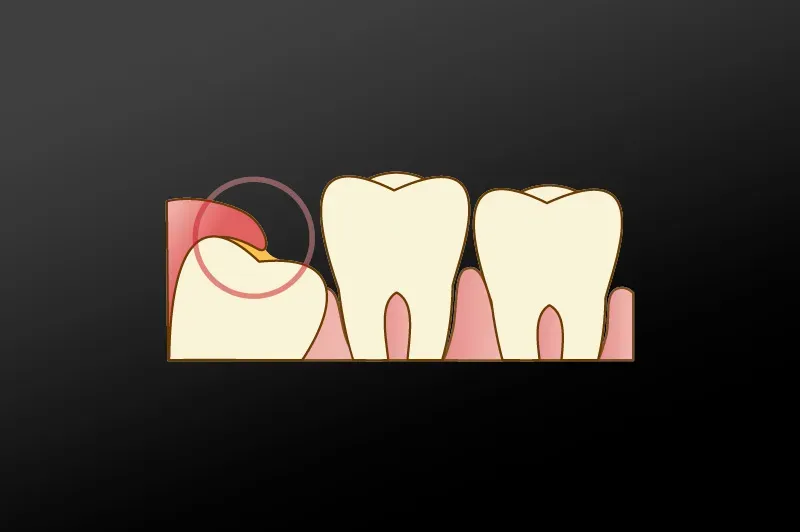
What is a wisdom tooth (the third molar)
Counting from your front tooth, a wisdom tooth is the 8th permanent tooth, formally known as the “third molar”. It usually comes through between the late teens and early twenties. Because modern jaws tend to be smaller, there is often not enough room for it to come in straight. This can leave it as an “impacted tooth”, buried in the bone with no way to come through, or as a “misaligned tooth” that grows at an angle or sideways.
Symptoms worth a visit
Pain and swelling
Swelling around your back teeth, or difficulty opening your mouth. If you have trouble swallowing or breathing, or the swelling suddenly gets worse, go to a medical institution as soon as possible.
Recurring inflammation
Swelling or discomfort that keeps coming back in the same spot when you are run down.
Effects on the tooth in front
Debris building up between the wisdom tooth and the tooth in front, which may be causing tooth decay or periodontal disease.
When extraction is recommended (cases where early removal is advised)
Not every wisdom tooth needs to come out, but as a precaution, we recommend early removal in the situations below. Once inflammation has worsened, anaesthetic works less well, and the procedure itself can become more demanding.
Pericoronitis (repeated pain and swelling)
A wisdom tooth that has only partly come through easily traps debris and food between itself and the gum, which can lead to a bacterial infection called “pericoronitis”. Left untreated, the inflammation can spread to the surrounding tissue and even the jawbone, sometimes with facial swelling or difficulty opening your mouth.
Tooth decay in the wisdom tooth and the tooth in front
Because it sits at the very back of the mouth, a wisdom tooth is hard to brush properly, which raises the risk of decay not only in the tooth itself but in the tooth in front of it. To protect that tooth, removing the wisdom tooth is sometimes considered.
Pressure on the tooth in front (root resorption and crooked teeth)
A wisdom tooth impacted sideways can keep pressing on the tooth in front, which may dissolve its root — what is known as “root resorption” — and can also be one cause of crooked teeth.
Formation of a dentigerous cyst
Even when a wisdom tooth is fully buried in the bone, an X-ray or CT scan can sometimes find a sac-like growth around it called a “cyst”. As a cyst grows, it can erode the jawbone or press on a nerve, so removing the wisdom tooth together with the cyst is sometimes necessary.
Treatment process
Examination and imaging
We check the direction the wisdom tooth is growing and how it sits in relation to the nearby teeth and nerves.
Explanation of the treatment plan
We explain why the extraction is needed, how it will be done, and the swelling and pain you might expect.
Extraction, or referral to a medical institution
If we judge that we can treat it in-house, the extraction is carried out under local anaesthetic. If the wisdom tooth is in a complex position, or your general health needs to be taken into account, we will refer you to a partner medical institution.
After the procedure
Once we have confirmed the bleeding has stopped, we will go through what to know about eating, cleaning and medication.
Follow-up visit
If needed, we disinfect the wound, remove any stitches, and check how it is healing.
Aftercare
After the extraction you may have pain, swelling, bleeding or difficulty opening your mouth. Rinsing vigorously, drinking alcohol, strenuous exercise and smoking all slow healing, so please avoid them. For a wisdom tooth in a complex position, we may refer you to a partner medical institution.
FAQ
Q1. Does the extraction hurt?
We give you a thorough anaesthetic beforehand, so you should feel little to no pain during the procedure itself. If you are anxious about dental treatment, please ask us about the anaesthetic options before we begin.
Q2. Will it swell up a lot afterwards?
How much it swells varies from person to person, depending on how the wisdom tooth was impacted and how difficult the extraction was. Even when it does swell, it will usually go down within about 1 week. If swelling or pain lasts longer than that, please contact us.
Q3. Can it be removed on the day of my first visit?
Depending on your symptoms — for example, if the inflammation is mild — extraction on the day of your first visit is sometimes possible. If there is significant inflammation, we will treat that first and schedule the extraction for another day. Please ask us about your case when you come in.
Q4. Do all 4 wisdom teeth need to come out?
Not every wisdom tooth needs to be removed. If one is growing straight and is doing its job in chewing, it can sometimes be kept. We check each tooth’s condition with an X-ray or CT scan before making a recommendation.
Booking and enquiries
